
How Much Strength Training Do You Need? (Including a Session to Start With)
One of the most common things I hear from new clients at our Bristol gym is some version of: "I know I should be doing more."
More sessions. More exercises. More effort. More time.
But when I ask what they're actually doing, almost nobody is doing too little. They're doing too much of the wrong things — and not enough of what actually produces results.
This post is about the minimum effective dose of strength training. What the research says. Why it's probably less than you think. And a real session you can take to the gym this week.
What Is the Minimum Effective Dose?
The minimum effective dose is a concept from medicine — the smallest amount of something needed to produce the desired effect. Anything above that threshold doesn't give you more benefit, it just adds cost.
Training follows the same logic. There's a stimulus threshold you need to cross to trigger adaptation — to build muscle, get stronger, improve your body composition. Below it, not much happens. Above it, you're accumulating fatigue without proportional return.
The question is: where's that threshold for most people?
The answer, consistently, is lower than the fitness industry wants you to believe.
What the Research Actually Says
A 2019 meta-analysis found that one to three sets per muscle group, performed twice per week, produced significant gains in strength and muscle mass — particularly in people relatively new to training.
Separate research comparing twice-weekly versus three-times-weekly training frequency found broadly equivalent results for muscle growth, with the twice-per-week group doing less total volume overall.
The practical conclusion: for most people, especially beginners and intermediates, two quality sessions per week is enough to produce real, meaningful change. Three sessions per week offers a modest additional benefit. Beyond that, the returns diminish quickly and the fatigue accumulates.
Frequency is overrated. Consistency is everything.
Why Compound Movements Change the Equation
The other piece that makes two sessions genuinely sufficient is exercise selection.
Most people's programmes are heavy on isolation movements — bicep curls, tricep pushdowns, lateral raises, leg extensions. These aren't bad exercises. But they're inefficient if your time is limited.
Compound movements — exercises involving multiple joints and muscle groups — deliver far more return per set. A squat trains your quads, hamstrings, glutes, and core simultaneously. A row hits your back, biceps, and rear delts in a single movement. A hinge pattern covers your entire posterior chain.
Four well-chosen compound movements can cover your whole body. Which is exactly what the session below is built around.
The One Variable That Actually Matters
Before the session — one concept worth understanding.
Progressive overload is the practice of giving your body a slightly greater challenge over time. More weight. More reps. Better technique under the same load. Something has to move forward.
Without progressive overload, you can train five days a week for years and not change much. With it, two days a week is enough to build a genuinely different body over twelve months.
It's not the most exciting concept. But it's the one that separates people who make progress from people who just maintain.
The Session
This is built around four movement patterns: squat, hinge, push, pull. Cover these and you've covered your whole body.
Movement 1 — Squat Pattern: Goblet Squat
Hold a dumbbell or kettlebell at your chest. Feet shoulder-width, toes turned out slightly. Sit down between your knees — not back onto your heels. Keep your chest up and your elbows tracking inside your knees at the bottom.
3 sets × 8–10 reps | 90 seconds rest
What to feel: quads working through the movement, glutes engaging at the top, core braced throughout. If you feel it in your lower back, your chest is probably dropping forward.
Movement 2 — Hinge Pattern: Romanian Deadlift
Dumbbells or barbell, soft bend in the knees. Hinge at the hips — push them back — as the weight travels down your legs. You're looking for a pull in the hamstrings, not rounding in the lower back. Drive your hips forward to return, squeezing your glutes at the top.
3 sets × 8–10 reps | 90 seconds rest
What to feel: hamstrings loading on the way down, glutes driving the movement back up. The hinge pattern is the most commonly missing movement for people who train in commercial gyms — and the one most protective of your lower back.
Movement 3 — Push Pattern: Dumbbell Press or Press-Up
Both are valid. The press-up is more underrated than people think.
Dumbbell press: dumbbells at chest height, elbows at roughly 45 degrees from your torso. Press up and slightly in. Lower with control.
Press-up: hands just outside shoulder-width, body in a straight line. Lower until your chest is an inch from the floor.
3 sets × 8–10 reps | 90 seconds rest
What to feel: chest, front shoulders, and triceps working. If it's mostly in your front delts, bring your grip slightly wider and focus on driving your elbows out and back on the way down.
Movement 4 — Pull Pattern: Dumbbell Row
One hand and knee on a bench for support. Pull from a dead hang up to your hip — not your shoulder. Drive your elbow back and up. Lower slowly and under control. The eccentric phase matters.
3 sets × 10–12 reps each side | 60–90 seconds rest
What to feel: your back doing the work, not your biceps. If your shoulder is shrugging up on the way, you're using too much weight or losing your lat engagement.
Full Session at a Glance
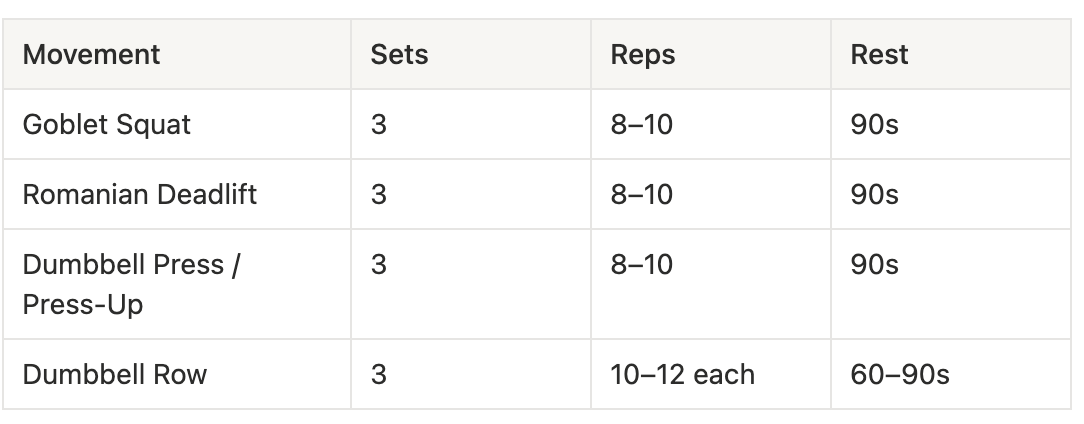
Total time including warm-up: 45–50 minutes.
Do this twice a week with at least one rest day between sessions. Add a small amount of weight or a couple of reps each week. That's your programme.
How Long Should You Run This?
Longer than feels comfortable. Most beginners should stay on a programme like this for three to six months before adding complexity. The temptation to switch things up usually arrives right as the boring, consistent work is starting to pay off.
Two sessions. Four movements. Progressive overload. Consistency over months.
That's the minimum effective dose. And for most people, it's the maximum necessary dose for quite a long time.
Opex Bristol offers small group personal training in Bristol, designed around exactly these principles — progressive, sustainable, coached. If you'd like to find out more, [get in touch here]. We also work with remote clients worldwide.